
1938
Cartoonist
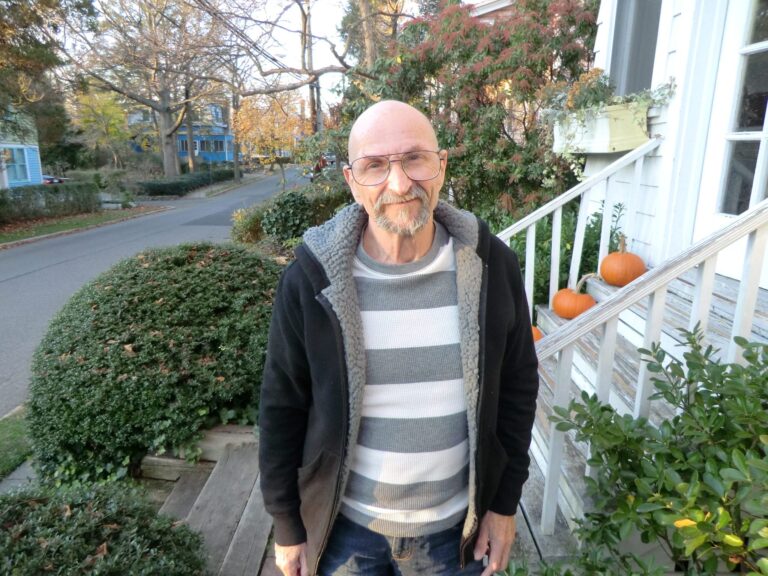
Arnold Levin is an American cartoonist whose works have been published in The New Yorker and other publications.
He received an award National Society of Cartoonists Gag Cartoon Award for 1991 and 1992.
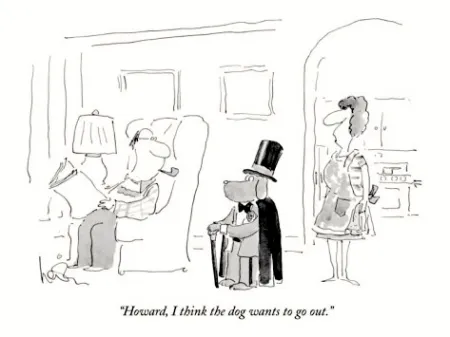
Arnie Levin is one of the many New Yorker cartoonists and cover artists whose style is probably not immediately recognized by readers, but whose constant presence since 1974 has been invaluable to the identity and success of the magazine.
Levin served in the Marines before becoming an aspiring artist during the heyday of the Beatniks in New York in the late fifties. “Shrouded in the glamour of the Beatnik era,” as he himself puts it, Levin collaborated with the espresso house, where readings by Allen Ginsberg and Jack Kerouac were arranged. He was working at parties as a hipster for hire and met Bob Dylan, another newcomer to the city, during one of these events. At Push Pin Studio, which was then at the peak of its influence on the design world, Milton Glazer pulled him out of the messenger pool, who recommended him to Lee Savage’s Electra Studio, known for its promising trailers and commercials. After leaving Elektra, Levin was hired at The New Yorker by art director Lee Lorenz in 1974.
Having started motorcycling at the age of fifty-nine, Levin celebrated his new hobby with a flurry of tattoos. However, he gave up cycling in the interests of personal safety.
Reference: tcj.com , 2018


RICHARD GER: You are a New Yorker who grew up in Florida. Where were you born?ARNIE LEVIN: I was born in the Bronx. For several years we lived in Flatbush, Brooklyn. My mother was a single mother. She was an accountant, but she wanted to become a writer. Her name was Dorothy Elfenbein. My grandfather Louis was a seltzer dealer with a truck and everything else. He was a very good man, but he was paralyzed; I do not know why or how. My mother married Ernest Levin, who eventually changed his last name to Pike. He wanted to be a writer. They both wanted to be fucking writers, so it was okay for me to be an artist.GEHR: Did you have a relationship with your father?LEVIN: When I went to get my passport, they asked me: “What is your father’s name?” I said, “Ernest.” And the girl said to me, “No, it’s not like that.” I said, “Yes, it is!” She said, “No. That’s not what’s here.” So I called my mom and aunt to ask if dad had any other names. Nothing like that. We were there all day, calling people. I was desperate because we were going on a trip and I needed a passport. Then the girl asked me, “What neighborhood did you live in?” I said Bronx, she said no. I said, “That’s impossible!” and asked her what she had down for his name. She said, “E.” [Laughter] I said, “E?” “Yes. E. Lawrence Levin.” She suddenly wants to become literary!GEHR: What was your mother’s family like?LEVIN: Her family is sometimes dysfunctional, but generally very good-natured. She started as an accountant in one of the real bars in Greenwich Village, and ended up working at the Rockefeller Center accounting firm next door to the William Morris agency. She kept the books of James Mason and other actors and came home with autographs. When she had to work on Saturdays, she took me with her. There was a small room to the side, and she sat me down with a yellow notebook and pencils. I sat and drew for hours, just looking at the street. The reward for this was a dinner at Tad’s Steakhouse on 42nd Street. And there was a nineteen-cent bookstore where I could buy New Yorker magazines for a dollar.GEHR: Did you continue drawing at school?LEVIN: The commercial art lesson at Miami Tech High School turned out to be incredible. For the first two years it was three hours a day, just studying art. And then there were supposedly related courses like English and mathematics, which the artists taught for another three hours a day. But they didn’t do anything. Everyone was just drawing all the time. And this guy, Kenneth Bair, studied with Kimon Nikolaides “The Natural Way of Drawing.” I was offered a scholarship to the University of Miami either in art or dance.GEHR: Were you a dancer too?LEVIN: I danced bop [laughs]. I won a citywide dance competition in Miami, and my partner and I were on television. My partner and I were against this fraternal-sisterly team. It was very dramatic.GEHR: Have you accepted the scholarship?LEVIN: I went to an art teacher at the university. I looked at his paintings and thought: “No…” By that time I was all excited about the classes, because Kenneth Baer told me about Pollack, who was dripping paint. So I dripped paint. I was a young expressionist.GEHR: How did you end up in the Marines?LEVIN: This guy said that if we joined the Marine Corps Reserve when we were still in high school and went to meetings for a couple of months, it would give us seniority. It sounded reasonable. When I enrolled, they found out that I was an artist, so I did silkscreen printing for them even before basic training. So we went to Parris Island, and I thought it was just wonderful, it’s like in the movies! Everyone played their roles that they had to play. And, of course, I ran.GEHR: You were eventually transferred to California, right?LEVIN: Our small group has gathered in Parris, and a lieutenant comes up and asks: “Who do you want to be?” “Infantry, sir! Infantry, sir!” And he comes up to me and I say, “I’d like to be a photographer” [laughs]. He’s, like, looking for something to hit. And I said: “I am an artist. You could use me for something good.” They had a photo school. I worked like a son of a bitch and became the third in the class. When it was my turn to choose where to stay, I saw the Mojave and asked: “Where’s Mojave?” This guy pulls out a big map, and the two of us look and look. Another guy comes up and the three of us watch [laughs]. I said, “If you can’t find it, that sounds good. I’ll take it.”GEHR: Did you do art there?LEVIN: Actually, yes. I don’t remember which one. I played the bongo; it was fun. I had watercolors. They called me a “Tourist” because I went out into the desert and painted. In addition, when I first went up to the base, I had to do CP, so they put me in the salad room. We cut the salad and stuff. We made one big tray with cottage cheese. We put it out, sprinkled with paprika, and people ate this unappetizing thing. So I decided to make a sculpture out of it. I started with a naked body lying down and got rave reviews. An additional advantage was that instead of tormenting him, people ate around the edges; so we could just fill it up and use it for another meal. I did so well with the first one that the White House did for the second one. I used parsley for the trees. Nothing particularly impressive,GEHR: How did you start drawing cartoons?LEVIN: When I came back to Miami, I was hanging out with all these musicians; the artists bored me, but the musicians gave me a lot of pleasure. And one night I got into a car accident. I ended up at home with a broken hip, two dislocated shoulders and a couple of other things.GEHR: That’s the end of your dancing career.LEVIN: Yes [laughs], although by that time I had not danced so much. Anyway, they put a pin in and I had these dislocated shoulders, so I had nothing to do. My mom had these Writer’s Digests, I look, and it says that you can send cartoons. You were supposed to send about twenty drawings. I said, “Okay, what do I have to lose?” So I got a stack of typewriter paper; and I don’t know what made me go for a bamboo pen [laughter], because it’s the clumsiest tool known to man. I started making drafts. I was sitting on the edge of the bed and drawing like this… [Laughter]GEHR: You were all hunched over, immobilized.LEVIN: Yes, except for a little wrist movement. So I made twenty drawings and sent them to Playboy. Then I quarreled with my mother and decided that I was tired of living with her. It was after I left the Marine Corps, around 1958. I already lived in New York, but I went back and forth.GEHR: What happened in New York?LEVIN: I went to the YMCA and they said, “Sorry, you can’t come in with a wheelchair.” [Laughter] I said, “Damn it, I can’t!” and really gave it to them. After I got out of the Marines, I wanted to study at the Art Students League of New York. It was my dream. And thanks to the law on the rights of servicemen, I was able to.GEHR: Did Playboy buy any of your drawings?LEVIN: About six months later, my mom calls and says: “I got a letter for you from Playboy. They bought the drawing and want you to finish it.” She sends it, and I look at it and think, how to finish? Is there something else? So I looked in the magazine and noticed gray shades in them. And two more diamonds that they wanted to buy in an envelope. So, I finished the first drawing and sent it back. Six months later, I was sent a check for $80. good! So I finished the next two drawings and six months later I received checks for $85 and $90. So it took me a year to earn about 200 bucks! [Laughter] It wasn’t a profession for me or for anyone.GEHR: And these were the only cartoons that you sold for a very long time.LEVIN: I started doing caricature again much, much later. I started studying at the Art Students League at the height of Expressionism. At that time, I was living on 91st Street, sharing a room in a brownstone house with a guy who went to the Connecticut School of Broadcasting. I was hanging around a coffee shop called Seven Arts Coffee Gallery, up on Ninth Avenue. I hung around and ended up staying there.GEHR: The Seven Arts Coffee Gallery was kind of a beatnik hotspot, wasn’t it?
LEVIN: The elusive Spondulla.


