Cartoonist, animator, illustrator
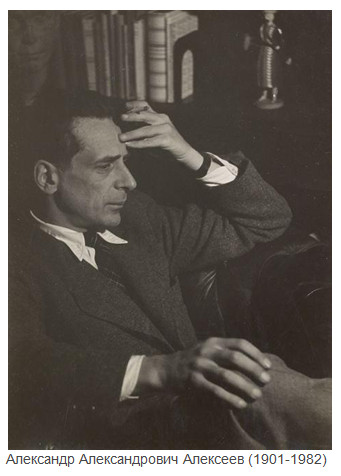
Born on April 18, 1901 in the Russian Empire, he lived and worked mainly in Paris. He and his second wife, Claire Parker (1906-1981), are credited with inventing an animation technique called pin-screen.
Alekseev was born in Kazan. He spent his early childhood in Istanbul, where his father, Alexey Alekseev, was a military attache.
After the death of his father, the family first settled with his uncle near Odessa, then moved to Riga and finally settled in Gatchina, Russia, near St. Petersburg.
In Riga, Alekseev saw a movie for the first time. It made a big impression on him. He was surprised to see that the image projected on the screen could be seen reflected from the lens of the projector, which was not far from where he was sitting. Later he realized that the image on the lens was the original.
Alekseev entered the St. Petersburg Cadet School at the age of seven. His favorite subject was drawing. His art teacher taught his students to draw from memory. He carried various objects around the classroom, for example, a violin, took it out and asked the students to draw it. This early training was invaluable to Alekseev later, when he became an illustrator.
When the Russian revolution of 1917 began with general strikes in St. Petersburg, the school was closed for three days, and Alekseev returned to his home in Lesnoye. Soon after, he received news of the arrest and abdication of Tsar Nicholas II. When Alekseev was a teenager, he was drawn to communism. However, the arrest and execution of his mother’s brother by the Bolsheviks forced him to reconsider his position.
Life in Paris
In 1921, Alekseev moved to France and began working on the design and painting of the scenery for the Pioteev Theater.
In 1923, he married Alexandra Alexandrovna Grinevskaya (1899-1976), one of the leading actresses of the avant-garde theater, where Alekseev worked. When Konstantin Stanislavsky arrived in Paris and saw her performance, he offered to return to Russia, but Alexandra refused and stayed next to Alekseev. Their daughter Svetlana was born in 1923.
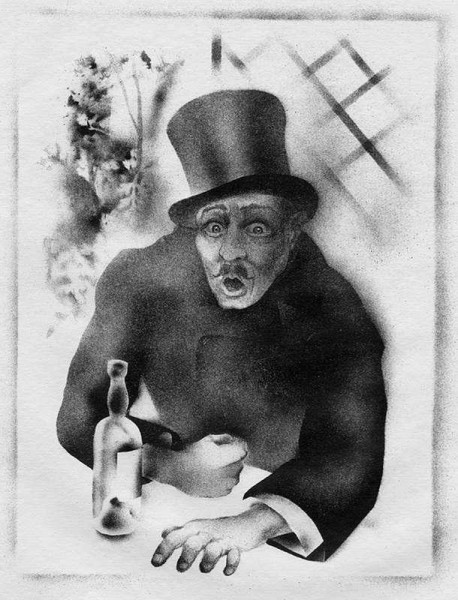
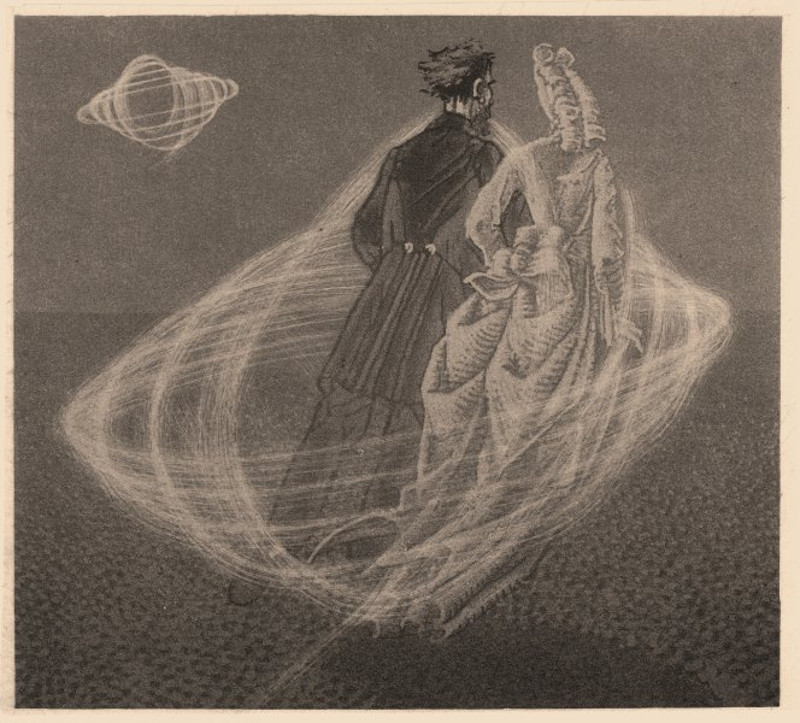
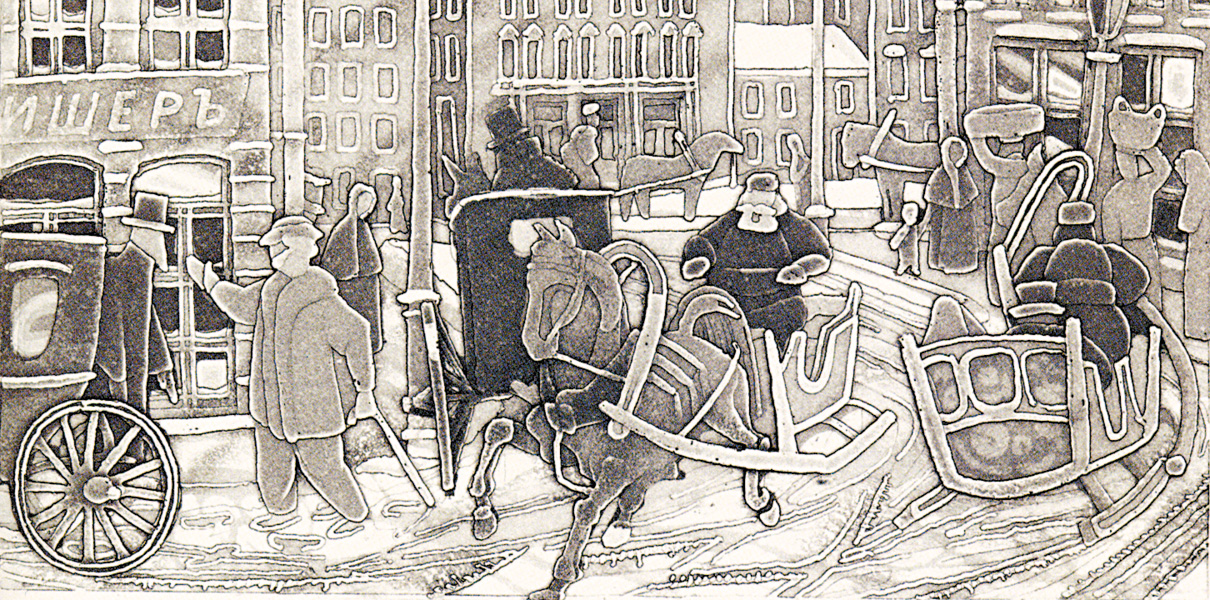
Alekseev became famous during this period shortly after he illustrated his first books. However, he lost one lung when he used nitric acid to make his aquatints, and was forced to spend two years in a sanatorium. Although the invention of the pin screen is usually attributed to Claire Parker and Alekseeff, Alexandra Grinevskaya-Alekseeva was the first to help Alekseev build a pin screen with the help of her eight-year-old daughter. 2
Relationship with Claire Parker
Claire Parker (1910-1981), a wealthy American, a graduate of the art department of the Massachusetts Institute of Technology, came to France in 1931 to study art. She saw Alexiev’s work in the window of a bookstore and was very impressed. Alexeev and his wife agreed to accept Claire as a boarder and student. A few months later, Claire became Alekseev’s mistress. Grinevsky took the situation with difficulty. They have collaborated on various projects. When they started making films, Claire became a cameraman, and Grinevsky built and painted the scenery. However, after the construction of the first large needle screen (or needle screen, or needle screen), Parker and Alekseev became independent.
Alekseev, Parker and Grinevskaya shot about 25 commercials with frame-by-frame animation to support themselves financially, although it seems that they did not see much difference between their “artistic” and “commercial” films. Although most commercial and feature films are attributed to Alekseev and Parker, it is difficult to separate the contributions of each of the people who made up Alekseev’s team. The group consisted of Alexandra Grinevskaya, Etienne Raik, Pierre Gorodich and Georges Violette.
Having built the first big screen, Alekseev and Parker began work on the first film in 1931, “Night on Bald Mountain”, an adaptation of a play by Modest Mussorgsky, their favorite Russian composer.
The pin-screen technique made it impossible to erase the captured images after they were drawn. After the image was taken, it was impossible to fix it. We had to wait for the film to come back from the lab. Thus, two years of work were conceived, so to speak, in the dark. Given the ephemeral nature of the pinscreen, Alekseev did not make sketches for the film, since he composed every frame in his head and immediately shot it.
The reception in Paris was very encouraging. Newspaper articles were positive, artists and film critics believed that the team managed to create a more serious type of animation, moving away from cartoons. However, it soon became apparent that working with the pin screen was time-consuming and therefore expensive to use. Consequently, major studios have never offered to use pinscreens, with the exception of the National Cinematography Council of Canada.
In 1936, Alekseev was hired by the German film group in Berlin to manage an animation studio. He made several animated films for German production and returned to Paris shortly before the German annexation of Austria. When the Germans invaded the Netherlands and Belgium in 1940, Alekseev expected German film producers to come to him with a request to make propaganda films, which he would have refused. So he packed everything into his old Ford car, and the family fled south to get visas at the U.S. Embassy in Bordeaux.
Alekseyev divorced Alexandra Grinevskaya and married Claire Parker in 1940, after arriving in the United States. In 1943, they moved to Canada and made their second feature film, Passing By, with financial support from the National Film Board of Canada. The premiere took place in 1944.
Return to Paris
When Parker and Alekseev returned to Paris in 1946, they made several promotional films. Alekseev invented a technique called “Summation of illusory bodies” or simply “Summation”. This process consists of shooting a moving object with a long shutter speed in order to fix the trajectory of movement. The resulting image gives the appearance of a solid object. For example, the trajectory of a pendulum taken in this way will look like a solid semicircle. This technique gave his ads a unique look.
Alekseev and Parker also continued to make films on the pin screen. In 1962, they used it to make the prologue to Orson Welles’ adaptation of Franz Kafka’s novel The Trial, the only major film in which Alekseev and Parker participated. However, they did not animate the pin screen for this sequence. Instead, the still images created on it were shot while Orson Welles read Kafka’s parable “Before the Law” over it.
“The Nose” based on the satirical fairy tale by Nikolai Gogol was released in 1963 and became the first feature film shot on a screen. The film tells the story of a Russian official who lost his nose, and the adventures of the nose itself, as well as the barber who found it.
On August 7, 1972, Alekseev and Parker were invited back to Canada to demonstrate a pinscreen to a group of animators from the National Cinematography Council of Canada. This demo was filmed and published by NFB as Pinscreen.
His last film “Three Moods” (Trois themes) was filmed on the cinema screen and first shown in Milan, Italy, in March 1980. It was based on three works by Mussorgsky.
Parker died in 1981 in Paris, and Alekseev followed Claire a year later. Both are buried in Nice, France. She and Parker had no children.
Pin screen
Alekseev is best known for his invention of the pinscreen, with which he shot about six short films.
The pin screen, on which Alekseev created his unusual black-and-white films, is a vertical perforated board measuring three hundred by four inches, into which a million steel pins without heads are inserted. When the pins are recessed and lit obliquely, they create a completely black surface in the front of the board. When you click up, the white color of the board is visible. Different shades of gray are created between them.
The first prototype was made by Alexandra Grinevskaya with the help of her daughter Svetlana. It consisted of a perforated cloth with a mesh into which pins were inserted. Later, Claire Parker and Alekseev built the first big screen, which was used for the filming of the film “Night on Bald Mountain”. The Parker family paid for its construction.
Alekseev never made sketches before creating images on the screen. He conceived each of the stages on the positive side of the screen, and Claire worked on its reverse side. Small tools were used to create various patterns on the board, such household tools as forks, spoons, knives, brushes, cups, prisms and rolling pins.
Reference: Wikipedia, 2018