

Cartoonist
The first cartoon of Mick Stephen was published in the magazine “New Yorker” in 1979. His work has appeared in several other publications, including Harvard Business Review, Barron’s, The National Law Journal, and USA Weekend. His published books include “Turn on If Ducks Carried Guns,” “What Not to Do Today,” and “Mystery Wrapped in Enigma Served on Lettuce Leaves.”
Reference: CartoonStock.com, 2020
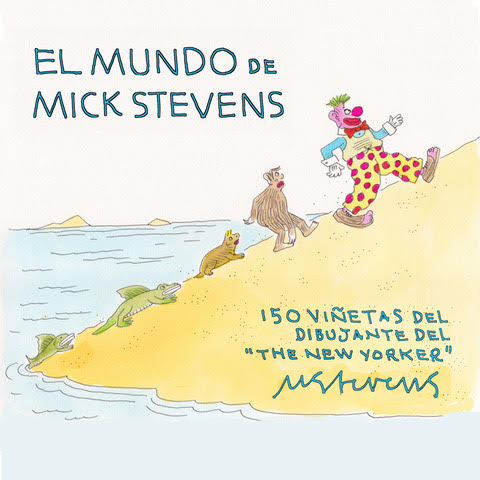


Mick Stevens.
Biography: I started drawing when I was about 5 years old, drawing with a pencil on everything that was at hand. When I was about nine years old, I received my first rejection letter. I drew a bunch of Disney characters and sent them to Disney headquarters in California. I probably addressed them directly to Walt himself–then I leaned back in my chair and waited. I assumed that Walt would be so impressed with my work that he would want to hire me immediately, making him the youngest artist ever hired by his organization. The inevitable rejection letter arrived many weeks later. I thought it was a little colder than necessary, informing me that “The Disney Company does not comment on the work of amateurs” or something like that.
I still continued to draw and did cartoons throughout my elementary and high school, as well as during my four-year military service. I published my work in places whenever and wherever I could, mostly in small newspapers or yearbooks. For the first time, I was actually paid by a magazine called “Our Navy”, and I started sending works to civilian magazines. I retired from the Navy after a four-year tour of duty with a letter of thanks (official recognition of my work and minimal impact on crew morale) and an honorable discharge, but neither helped me to work as a cartoonist later.
In the following years, I had several short-term part-time jobs, and I always continued to draw in my spare time or in the company, sending cartoons to magazines and trying to come up with ideas for cartoon tapes. I’ve been doing animation for a while, working for free at a company in San Francisco that had a contract with PBS to make short films for Sesame Street. I’ve worked on other people’s projects and also made two or three of my own, writing scripts and making key drawings. In the 70s, I also worked for Rolling Stone magazine, which was then based in San Francisco. I also sometimes made drawings for them, although in fact my job was to make layouts and pasting in the production department. I also had another job – I was engaged in producing and sometimes painted for other local magazines and advertising agencies.
At some point I decided that instead of sending my cartoons to the disparate and shrinking small markets available for magazine cartoons at the time, I could also shoot for the best, so I started sending works to The New Yorker. I also got my share of rejections from them, but continued in the same spirit. First I sent to the New Yorker, and then I sent the defective goods to other markets, where I sold them from time to time. One day, a couple of years after that, I received a note from Lee Lorenz, then the cartoon editor of the New Yorker, saying that they would like to purchase one of my ideas, but not my drawing for it. It turned out that they often bought ideas, which they gave to one of their full-time artists for revision. I was happy, but at the same time very disappointed that my drawing did not get into the clipping. After that, I sold a few ideas, which in the end, to my great surprise, were transferred mainly to Charles Addams.
Somewhere in the midst of all this, at the end of 1979, the magazine bought a real cartoon from me, a drawing and all that. It was called “Life without Mozart” and was published in 1980. I still get requests to reprint it.
A few months later, they bought another one, then, after a while, another one. There was still a lot of time between those windows, and so I continued to do other types of work to survive while still getting occasional sales. Eventually I went to New York, where I met some of my heroes (Jack Ziegler, Sam Gross, Bob Mankoff and Roz Chast, among others), as well as to be closer to the magazine and live in the city permanently. I got more orders, and after another year or so of weekly applications from the magazine, I got a contract at The New Yorker. I’ve been making 10 cartoons to review every week for over 35 years.


